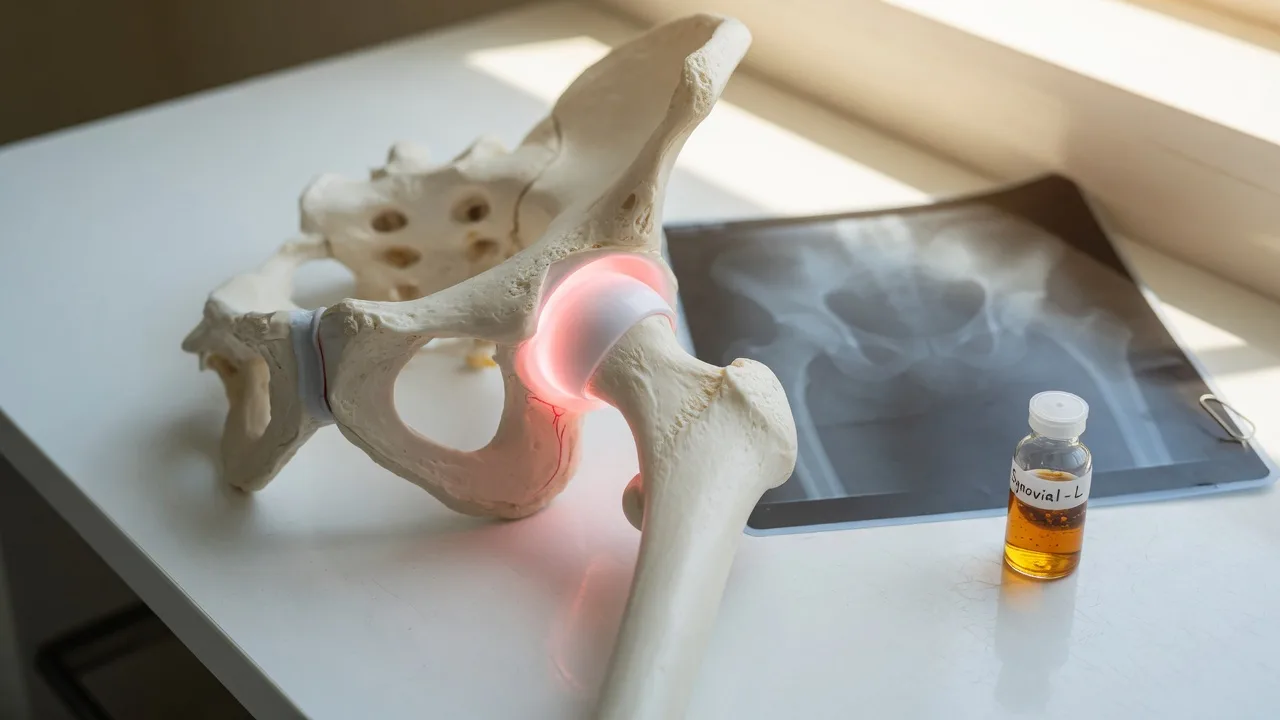
PRP and Stem Cells for Hip Labral Tears and FAI: What the 2026 Evidence Really Shows
PWritten by: Phil KimMedically reviewed by: Dr. Robert Aki, DPMLast medically reviewed: October 22, 2026
Hip pain that feels like it lives deep in the front of the groin, sometimes with clicking or catching, is often traced to a labral tear or to femoroacetabular impingement (FAI), a shape mismatch between the ball and socket of the hip. Both are common among active people, and both are increasingly pitched alongside PRP and stem cell injections. The 2025-2026 evidence, read honestly, is mostly a story of what these injections do not yet clearly add, with a few modest exceptions. This article explains where the science stands.
113
patients in the randomized single-blinded trial cited in a 2026 review, which found no significant difference in hip outcomes with PRP at 2 years or more
24 mo
when functional differences favoring bone marrow aspirate concentrate began to reach significance in a 2025 JBJS study of labral repair
2 yr
minimum follow-up in a December 2025 study finding PRP did not improve outcomes after hip arthroscopy for FAI and labral tears
What a labral tear and FAI actually are
The labrum is a ring of cartilage that deepens the hip socket and helps hold the ball of the joint in place. A labral tear is a split or fraying in that ring, and FAI is a bone-shape mismatch that can pinch and damage the labrum over time. Both are common in athletes, dancers, and active people, and they often show up as deep groin pain, stiffness, or a catching sensation. Because the pain sits so deep, it is frequently blamed on the lower back or the groin muscles before the hip is looked at carefully.
What the 2025-2026 PRP evidence shows
The most recent evidence on PRP for the hip is largely neutral. A study published in December 2025 in the Journal of Hip Preservation Surgery reported that adding PRP during hip arthroscopy for FAI and labral tears did not improve outcomes at a minimum two-year follow-up compared with a matched control group. A 2026 narrative review reached the same conclusion, citing a prospective randomized single-blinded trial of 113 patients that found no significant between-group difference in standard hip outcome scores at two years or more. Against that, one small 2025 case-control study of 40 patients found improved labral healing and functional outcomes at 12 months after injecting leukocyte-rich PRP into the repaired labrum, but that is lower-level evidence and has not been replicated.
“Across the 2025-2026 studies, PRP has not shown a clear added benefit after hip arthroscopy for femoroacetabular impingement and labral tears at two years or more, while one small 2025 case-control study reported improved labral healing with PRP at 12 months.”
What about bone marrow stem cell concentrate?
The stem cell picture is modest and still unproven. A 2025 systematic review and meta-analysis of bone marrow aspirate concentrate (BMAC) added to acetabular labral repair found patient-reported outcomes not significantly different from controls at 12 or 24 months, though with trends favoring BMAC. A separate 2025 study in the Journal of Bone and Joint Surgery reported significantly greater functional improvements with BMAC at five years, with differences generally reaching significance only around 24 months. Researchers in this area consistently call for higher-quality randomized trials. It is also important to note that these are studies of cells added during surgery, not standalone injections given in a clinic.
The honest bottom line for injections
For hip labral tears and FAI, the 2026 evidence does not support a regenerative injection as a substitute for the right diagnosis and, where indicated, the right treatment. The modest BMAC signal appears when cells are added at the time of surgery, not as a standalone office injection, and even that signal took up to two years to show up. A standalone PRP injection is not a proven fix for a torn labrum. None of this means regenerative medicine has no role in hip pain; it simply means hip arthritis and surrounding muscle and tendon problems are a different question from a torn labrum, and they should be evaluated as such.
How a Honolulu evaluation should work
For Honolulu's active population, deep groin pain deserves a careful workup before any injection is discussed. That means imaging, often an MRI or MR arthrogram, and an assessment of the whole hip: the labrum, the joint cartilage, the surrounding muscles, and how the bones fit together. For someone who paddles, hikes, runs, or practices hula or dance, the plan should be built around what is actually torn or impinging, not around a one-size-fits-all injection. When regenerative care does fit, it is part of a plan that includes rehab, not the whole plan.
Questions to ask about a hip injection
Is my pain from the labrum, the joint cartilage, the surrounding muscles, or more than one of these?
What does my imaging show, and was it read by someone who looks at hips regularly?
What exactly is being offered, a PRP injection, a bone marrow concentrate, and what does the evidence show for that product in the hip?
Is this being offered as a replacement for surgery, or as an addition to it?
What is the rehab and activity plan around the treatment, and who supervises it?
What is the plan if it does not help, including surgical options?
A note from the clinic
At Aloha Stem Cell in Honolulu we are direct about what the hip evidence does and does not support. We evaluate labral tears and impingement carefully, refer for imaging and specialist opinion when that is the right next step, and only discuss regenerative therapy where it fits honestly within your plan. Call (808) 593-2525 or book a consultation.
Our team is happy to listen to your story, answer your questions, and help you decide
whether a consultation makes sense. There is no pressure and no obligation.
The 50th Turkey Trot has come and gone, and Honolulu's December race season is here: the Santa Hat 5K, the Jingle Bell Jog, the JAL Honolulu Marathon on December 13, and the Hawaii Kai Ultra Run. Here is what the next three weeks mean for your knees, tendons, and the timing of any regenerative treatment.
December is when flexible spending account dollars run out, and PRP or stem cell therapy for a diagnosed joint or tendon condition can be an eligible use of FSA and HSA funds. Here is how IRS rules actually work, what documentation you need, and what to ask your benefits administrator before year-end.
Regeneration Biomedical announced results on November 18, 2026 from its first-in-human Phase 1 trial of a Wnt-activated stem cell therapy for Alzheimer's: four of five patients showed cognitive improvement with no serious adverse events, and the FDA granted fast-track status. Here is what that does and does not mean.