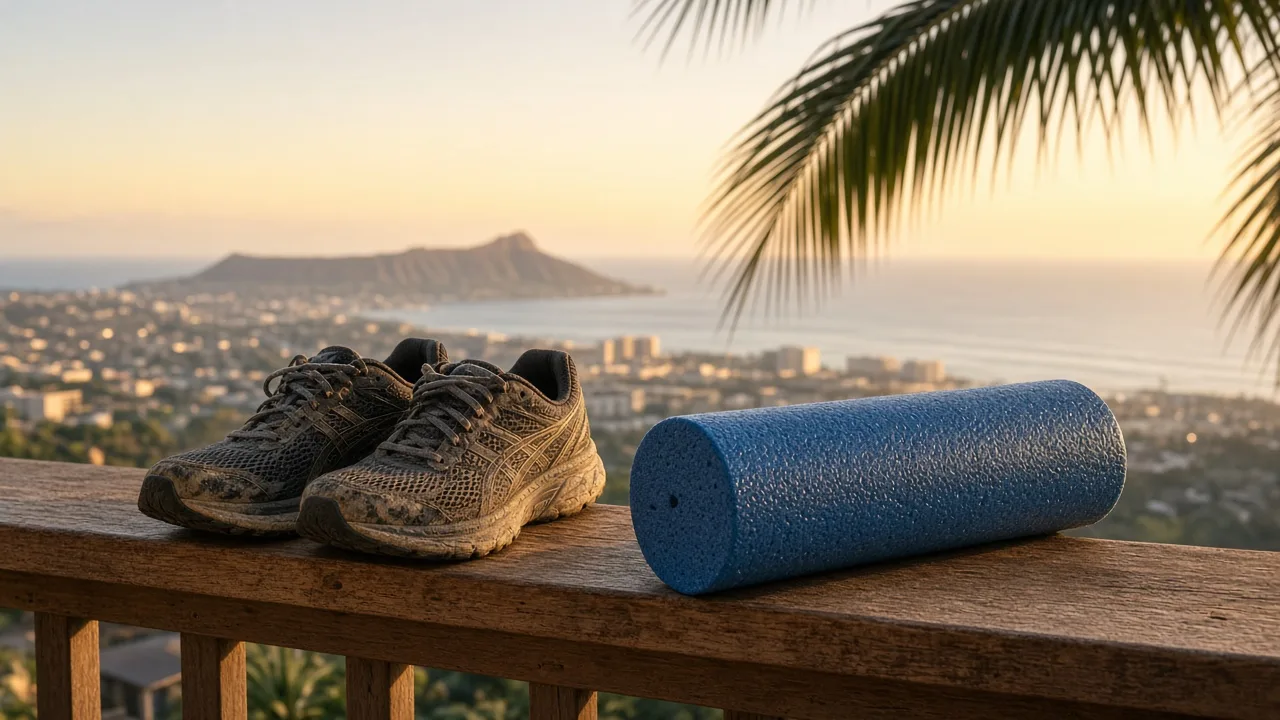
IT Band Syndrome and Plantar Fasciitis: The Injuries That Sideline Honolulu Marathon Runners
PWritten by: Phil KimMedically reviewed by: Dr. Robert Aki, DPMLast medically reviewed: November 13, 2026
The 2026 JAL Honolulu Marathon runs Sunday, December 13, and if you are training for it you are in the final month of the buildup: peak mileage, long Saturday runs, and the dull aches that come with both. Runner's knee gets most of the attention in marathon articles, but two other injuries take down just as many Honolulu runners: iliotibial band syndrome, the pain on the outside of the knee, and plantar fasciitis, the heel pain that greets you out of bed. Both are overuse problems, both respond to load management and strengthening before any injection is discussed, and both now have 2025 and 2026 research worth reading. Here it is, honestly.
1,653
patients pooled in a 2025 meta-analysis of 24 randomized trials comparing PRP with corticosteroid injections for plantar fasciitis
60
adults in the 2026 randomized placebo-controlled trial of PRP for iliotibial band syndrome
Dec 13, 2026
the date of this year's JAL Honolulu Marathon, which puts Oahu runners at peak mileage right now
Why December is the month marathon injuries show up
The Honolulu Marathon has no official time limit, which is one reason it draws one of the largest fields of any marathon in the United States. Training peaks in the four to six weeks before race day, exactly when cumulative mileage, heat, and humidity push tendons and fascia past their comfort zone. Honolulu in November and December is hot and humid even at the 5:00 a.m. start, which raises the strain on every run. IT band pain and plantar fasciitis are classic volume injuries: they rarely come from a single workout, and they usually announce themselves during the weeks of highest mileage rather than at the start of a program.
“The JAL Honolulu Marathon starts at 5:00 a.m. on Sunday, December 13, 2026, has no official time limit, and follows a mostly flat coastal course with the Diamond Head climb as its biggest challenge.”
IT band syndrome: the outside-knee pain that is not runner's knee
The iliotibial band runs down the outside of the thigh from the hip to just below the knee. When the glutes and hip stabilizers fatigue on long runs, the band can become irritated where it crosses the outside of the knee, producing sharp pain that starts around the same distance into every run. It is frequently mislabeled as runner's knee, but it is a different problem with a different fix: hip and glute strength, cadence work, and a temporary reduction in downhill mileage.
What the 2026 evidence shows about PRP for IT band syndrome
A 2026 randomized placebo-controlled trial gave 60 adults with IT band syndrome that had persisted despite at least 12 weeks of conservative care either an ultrasound-guided leukocyte-poor PRP injection or a placebo injection. The PRP group reported greater pain and functional improvement at six months, and more participants returned to their prior sport, with no serious adverse events. The honest caveats: it is one small trial, it is reported through a review article rather than as a standalone publication, and it needs replication before anyone should treat it as settled.
“PRP reached Level I evidence for iliotibial band syndrome in a 2026 systematic review, but extreme diagnostic and therapeutic heterogeneity across studies limits firm treatment conclusions.”
Plantar fasciitis: the heel pain that is common in marathon training
Plantar fasciitis is the most common cause of heel pain, and it thrives on the same conditions marathon training creates: a jump in mileage, hard surfaces, and calves that have not kept up. The classic sign is pain with the first steps out of bed or after sitting, which eases as the foot warms up and then returns after long runs. Most cases settle with calf stretching, foot strengthening, shoe changes, and gradual load increases, which is why an honest conversation about injections starts with whether conservative care has actually been tried.
What the 2025 and 2026 evidence shows about PRP for plantar fasciitis
A 2025 meta-analysis of 24 randomized trials with 1,653 participants found PRP significantly better than corticosteroid injections for pain at 3 and 6 months and for functional scores at 3, 6, and 12 months, with no significant difference at 1 month or 1 year. A second 2025 meta-analysis reported mixed results for pain relief but clearly favored PRP for functional improvement. The 2026 systematic reviews reach the same general shape: PRP looks at least as good as, and possibly better than, a steroid injection in the medium term, while short-term results are inconsistent.
“PRP may provide greater medium- to long-term improvements in pain and function than corticosteroid injection for plantar fasciitis, although short-term results are inconsistent.”
Why the corticosteroid comparison matters
Corticosteroid injections are the most common alternative offered for both IT band pain and plantar fasciitis, and they work fast: often a few days of relief while the inflammation settles. The tradeoff is that the relief can be short-lived, and repeated steroid injections into a weight-bearing tendon or fascia carry real risks over time. PRP is a slower play, measured in weeks, but the trials that favor it tend to find the benefit exactly where the steroid wears off, which is one reason it is worth discussing with a physician who treats these injuries regularly.
What an honest treatment plan looks like for a Honolulu marathoner
Keep running within the pain threshold: sharp pain that changes your stride is a signal to reduce volume, not to push through
Do the strength work: glute, hip, calf, and foot-strengthening exercises are the highest-evidence intervention for both conditions
Address load and shoes: softer surfaces, a slightly faster cadence, and well-fitting shoes reduce the strain that drives both injuries
Only after a genuine trial of conservative care, talk to a physician about imaging and whether an injection makes sense
The evidence says the same thing about both injuries: exercise-based rehab is first-line, and injections are a discussion that happens after conservative care has been given a real chance.
The honest bottom line for race day
Four weeks out, the highest-value moves are load management, strength work, and sleep, not an injection. If heel or lateral knee pain has persisted through a real trial of conservative care, PRP is a studied option for plantar fasciitis and an emerging, still-thin option for IT band syndrome, and the honest evidence says so. A clinic that promises a quick fix in the final month of training is selling something the data does not support.
A note from the clinic
At Aloha Stem Cell in Honolulu we evaluate runners through the same lens the evidence uses: history, imaging, and an honest read on whether conservative care has been tried. If an injection is worth discussing, we will say so, and if it is not, we will say that too. Call (808) 593-2525 or book a visit at our office on South King Street.
Our team is happy to listen to your story, answer your questions, and help you decide
whether a consultation makes sense. There is no pressure and no obligation.
The 50th Turkey Trot has come and gone, and Honolulu's December race season is here: the Santa Hat 5K, the Jingle Bell Jog, the JAL Honolulu Marathon on December 13, and the Hawaii Kai Ultra Run. Here is what the next three weeks mean for your knees, tendons, and the timing of any regenerative treatment.
December is when flexible spending account dollars run out, and PRP or stem cell therapy for a diagnosed joint or tendon condition can be an eligible use of FSA and HSA funds. Here is how IRS rules actually work, what documentation you need, and what to ask your benefits administrator before year-end.
Regeneration Biomedical announced results on November 18, 2026 from its first-in-human Phase 1 trial of a Wnt-activated stem cell therapy for Alzheimer's: four of five patients showed cognitive improvement with no serious adverse events, and the FDA granted fast-track status. Here is what that does and does not mean.