Bone Marrow vs. Fat-Derived Stem Cells: Collection, Evidence, and What to Ask in 2026
PWritten by: Phil KimMedically reviewed by: Dr. Robert Aki, DPMLast medically reviewed: October 2, 2026
When a clinic offers autologous cell therapy, the cells usually come from one of two places: your bone marrow or your fat tissue. Both approaches have real evidence behind them, but they differ in how they are collected, how many cells they yield, and how the 2025 and 2026 research reads. This article explains the difference in plain language, reviews the newest comparative evidence, and gives you the questions to ask before choosing.
30 of 32
successful cell culture growths in a 2025 pilot came from bone marrow, versus 2 from fat tissue
-1.23 / -1.09
pooled 6-month pain reduction (SMD) for adipose-derived vs. bone marrow-derived cells in a 2026 review
0
FDA-approved stem cell products for osteoarthritis today
The two main autologous sources
Autologous cell therapy means the cells are your own. The two dominant sources are bone marrow aspirate concentrate (BMAC) and cells from fat tissue, usually called adipose-derived cells. A third option, cells from your blood, exists but is less common in joint care. Because the material is yours and is prepared for same-day use, both approaches sit apart from manufactured, donor-derived products, and both are investigational for most conditions they are used to treat.
How bone marrow concentrate is collected
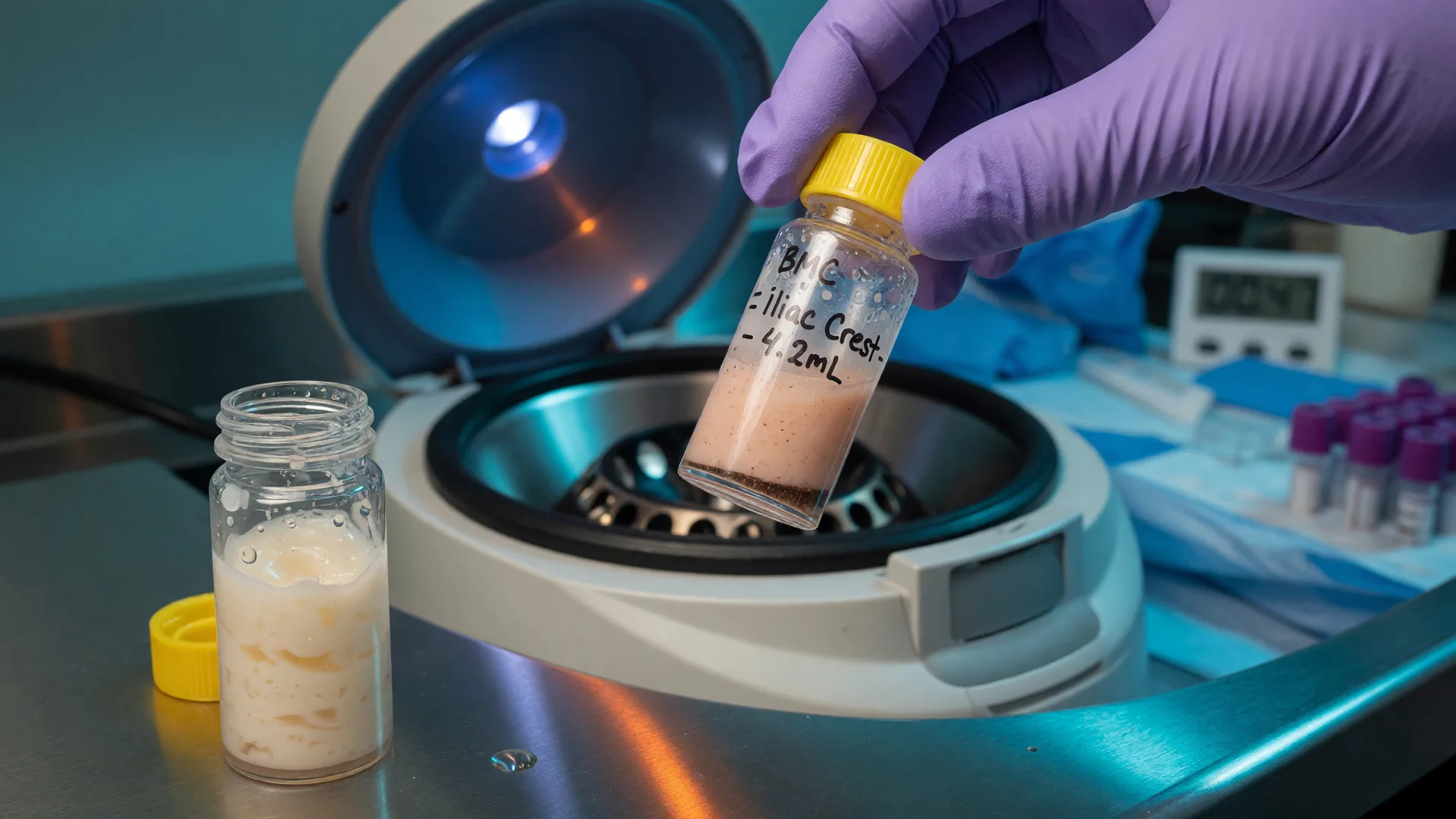
Bone marrow concentrate starts with a small aspiration, usually from the back of the pelvis at the posterior iliac crest, under local anesthesia. The marrow is then spun in a centrifuge to concentrate the cell-rich fraction. It is a single, minimally invasive puncture, but bone marrow yields relatively low numbers of stem cells, and those numbers decline with age. A 2025 expert consensus identifies the posterior iliac crest as the safest harvest site and emphasizes technique as the main variable in cell quality.
How fat-derived cells are collected
Fat-derived cells come from lipoaspiration, the same gentle suction used in liposuction, usually from the abdomen or thigh. The harvested fat is then processed either with enzymes into stromal vascular fraction (SVF) or mechanically into microfragmented fat (MFAT). Fat tissue yields far more cells per volume than bone marrow, which is one reason it is popular, but the harvest is a larger procedure and requires more preparation time.
What the newest comparative evidence shows
A 2025 pilot study of 60 patients with knee osteoarthritis gave patients under 50 bone marrow concentrate and patients over 50 fat-derived cells. Both produced significant clinical improvements at six months, with no significant difference between the groups. Bone marrow samples yielded higher stem cell counts and slightly faster early recovery, and when the researchers tried to grow the cells in culture, 30 of 32 successful cultures came from bone marrow versus only 2 from fat tissue.
“In a 2025 pilot study, both bone marrow concentrate and fat-derived cells produced significant clinical improvement in knee osteoarthritis at six months, with no significant between-group difference.”
The 2026 systematic review
A 2026 systematic review comparing adipose-derived, bone marrow-derived, and peripheral blood-derived stem cell injections for knee osteoarthritis found both adipose- and marrow-derived cells significantly reduced pain at six months, with pooled standard mean differences of about minus 1.23 for adipose-derived cells and minus 1.09 for bone marrow-derived cells. The review graded the certainty of evidence as moderate for adipose-derived cells and low for bone marrow-derived cells, and reported only mild, transient adverse events across sources. A 2025 updated meta-analysis reached a similar conclusion: both sources reduce pain, but neither substantially improves knee function.
“A 2026 systematic review found both adipose-derived and bone marrow-derived stem cell injections significantly reduce knee osteoarthritis pain at six months, with mild and transient adverse events across sources.”
A head-to-head trial is finally running
The field has long needed a direct comparison, and one is underway. An ongoing randomized controlled trial published in BMJ Open in 2025 is comparing bone marrow concentrate directly against microfragmented fat in knee osteoarthritis, which should give patients and clinicians the first high-quality head-to-head data. Until it reports, the honest summary is that both sources show benefit, neither is clearly superior, and the choice depends on your anatomy, your condition, and your provider's experience.
What this means for your decision
There is no single right answer between bone marrow and fat. A clinic should be able to explain why it recommends one source for your specific situation, how the cells are collected and prepared, and what the evidence does and does not support. The more important question than which source is 'better' is whether the clinic evaluates you carefully, prepares the material to a high standard, and is honest about the investigational status of cell therapy.
Questions to ask
Which source do you recommend for my condition, and why?
Where exactly is the material collected, how is it prepared, and who prepares it?
What does the published evidence for this source show for my stage of arthritis?
How many cells will be delivered, and how do you measure quality?
What does the full process involve, from collection to injection to recovery?
A note from the clinic
At Aloha Stem Cell in Honolulu, cell therapy is autologous and collected from your own bone marrow or fat tissue, prepared in the clinic for same-day use. We will walk you through which source fits your situation and why, and we will never recommend a treatment the evidence does not support. Call (808) 593-2525 or book a consultation to talk it through.
Our team is happy to listen to your story, answer your questions, and help you decide
whether a consultation makes sense. There is no pressure and no obligation.
The FDA now lists Regenecyte, a cord blood stem cell product, among approved cellular therapies. It is a real milestone for blood stem cell transplant patients, and it is not a treatment for joint pain. Here is what the approval is, what it is not, and why it matters when you read stem cell news.
In September 2026 the FDA granted Fast Track status to an experimental cell therapy for ALS, and in August researchers presented new Phase 1/2 data on a stem cell therapy for Parkinson's. Both are real advances and both remain investigational. Here is the honest read.
A stem cell-derived islet therapy restored insulin production in early trials, with 10 of 12 patients insulin-independent at one year. Here is what the 2025-2026 results show, what the FDA has and has not done, and what it means for people with diabetes.