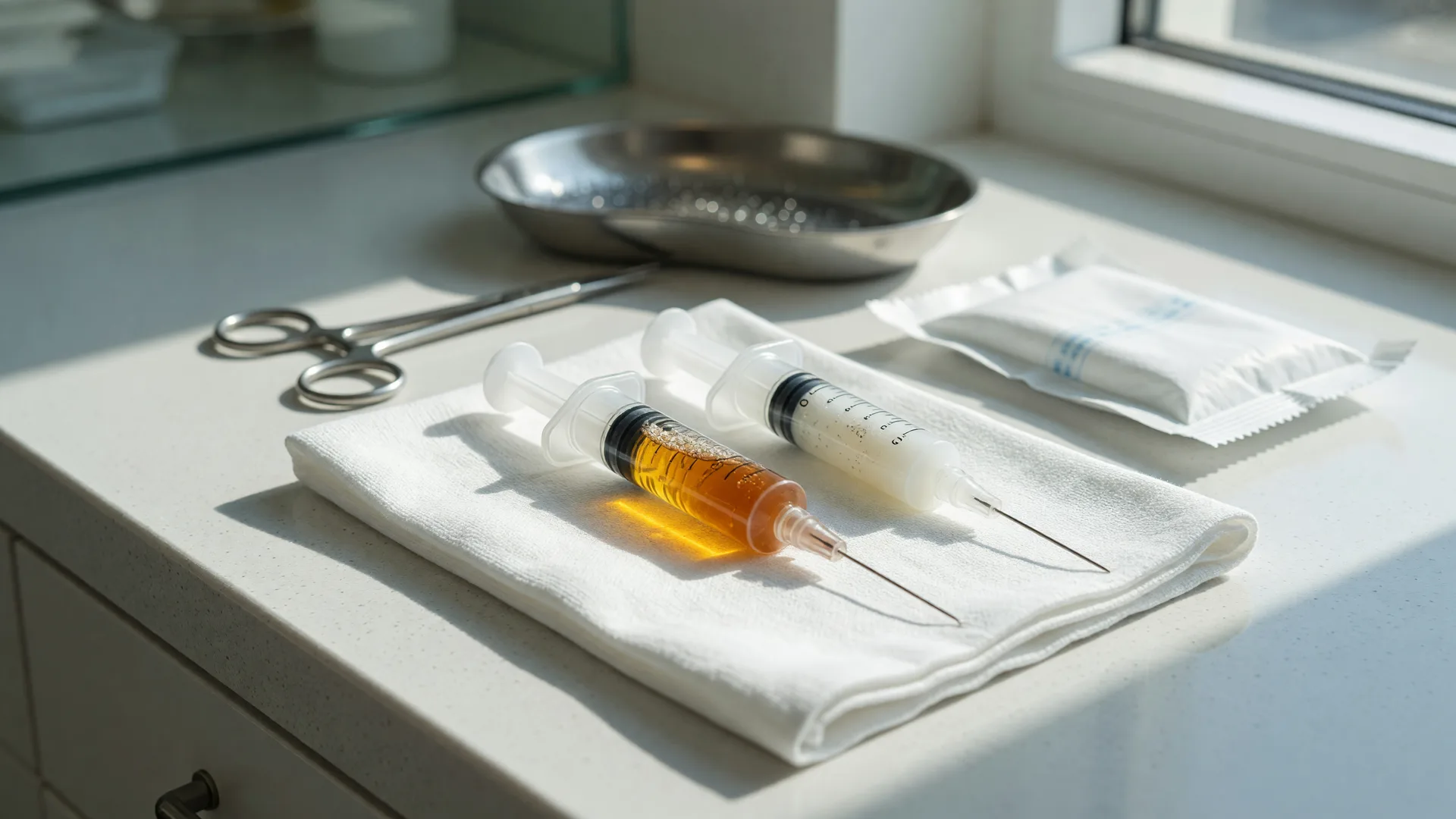
Cortisone vs. PRP for Joint and Tendon Pain: What the 2026 Evidence Shows
PWritten by: Phil KimMedically reviewed by: Dr. Robert Aki, DPMLast medically reviewed: October 29, 2026
Cortisone and PRP are the two injections you are most likely to be offered for arthritis or tendon pain, and they work in very different ways. Corticosteroids quiet inflammation quickly, often within days, while platelet-rich plasma (PRP) concentrates your own platelets and growth factors to support the body's repair process over months. Choosing between them is a genuine trade-off, and the newest 2026 evidence has made that trade-off clearer. This article reads the head-to-head trials and meta-analyses honestly, because the right answer for your knee, elbow, or heel depends on your timeline, your imaging, and your goals.
1-2 months
the window where corticosteroids deliver the fastest relief in head-to-head trials before their effect fades
3-12 months
the follow-up window where PRP is equal or superior in meta-analyses for knee arthritis, tennis elbow, and plantar fasciitis
42 studies, 3,696 patients
pooled in a meta-analysis finding PRP significantly reduced knee pain versus corticosteroid and hyaluronic acid injections
How cortisone and PRP actually work
Corticosteroids, commonly called cortisone, are potent anti-inflammatories. Injected into a joint or around a tendon, they quiet the inflammatory response quickly, which is why a cortisone shot often feels dramatically better within days. But they do not rebuild tissue, and the relief from a single injection tends to fade within weeks to a few months, especially with repeat dosing.
PRP works on a different principle. A small amount of your own blood is spun in a centrifuge to concentrate the platelets and growth factors it carries, then injected back into the damaged area to support the body's own repair process. The effect builds more slowly, usually over weeks, and the evidence suggests it is more durable. Choosing between the two is therefore a timeline question as much as a treatment question.
The pattern in the newest comparisons
The clearest finding across the 2025-2026 head-to-head literature is a consistent pattern rather than a single winner. Corticosteroids are the sprinter: they perform as well as or better than PRP in the first month or two. PRP is the marathoner: by three months and beyond it is equal or superior for pain and function in most comparisons, across knee osteoarthritis, tennis elbow, and plantar fasciitis.
Knee osteoarthritis
Knee osteoarthritis has the deepest evidence base, and the balance has shifted toward PRP at longer follow-up. A meta-analysis of 42 studies and 3,696 patients found that PRP significantly reduced pain compared with both corticosteroid and hyaluronic acid injections. A 2025 review reached a similar conclusion, noting that corticosteroids tend to lose effectiveness after four to six weeks while PRP's benefit lasts longer.
“In a meta-analysis of 42 studies and 3,696 patients, PRP significantly reduced knee osteoarthritis pain compared with both corticosteroid and hyaluronic acid injections.”
Safety deserves an honest mention. A 2025 meta-analysis of complications in knee injection studies found that PRP's odds of complications were not significantly different from corticosteroids'. Both are low-risk procedures in experienced hands, but corticosteroid side effects, including questions about cartilage with repeated dosing, mean the instinct to 'just try a cortisone first' deserves a deliberate pause.
Tennis elbow and lateral elbow tendinopathy
For tennis elbow, the trade-off shows up clearly in the numbers. A meta-analysis of randomized trials published in 2025 found corticosteroids superior for pain in the first two months, with PRP significantly better after six months. A one-year randomized trial published in January 2026 in 48 patients with chronic lateral elbow tendinopathy adds fresh support for PRP's longer-term benefit, while another 2025 trial found the two injections similar at twelve weeks, with corticosteroids superior only in the first month.
“For lateral elbow tendinopathy, a meta-analysis of randomized clinical trials found corticosteroids superior for pain in the first two months, while PRP was significantly better after six months.”
Plantar fasciitis and heel pain
The heel is where Honolulu residents feel this decision most, since plantar fasciitis is common among walkers, runners, and hikers. A meta-analysis of 24 randomized trials and 1,653 participants found that PRP significantly outperformed corticosteroids for plantar fasciitis pain at three and six months, with no significant difference at one or twelve months. Function scores also favored PRP at three, six, and twelve months.
“In a meta-analysis of 24 randomized trials and 1,653 participants, PRP significantly outperformed corticosteroids for plantar fasciitis pain at three and six months, with no significant difference at one or twelve months.”
What the honest takeaway is
If your main goal is fast relief while you start a rehabilitation plan, a corticosteroid can be the right first step in many situations, in discussion with your clinician.
If your priority is a result that lasts for months rather than weeks, PRP has the stronger evidence in most head-to-head comparisons, though results vary by condition and preparation.
Safety profiles look broadly similar at the meta-analysis level, but corticosteroids are not risk-free with repeat dosing, and PRP costs more and is generally not covered by insurance.
An injection is one tool in a plan that also includes strengthening, load management, and often weight loss. No injection is a substitute for the plan.
The bottom line
There is no universal winner between cortisone and PRP, and anyone who tells you otherwise is oversimplifying. The evidence supports a deliberate conversation: determine what is actually wrong, decide what timeline matters to you, weigh the cost, and then choose. For people who want fast relief while they get moving, corticosteroids remain useful. For people who want the best chance of improvement that lasts months, PRP is the more defensible choice in most of the recent head-to-head data.
A note from the clinic
At Aloha Stem Cell in Honolulu we discuss the cortisone versus PRP decision the way we discuss any injection: with your history, your imaging, the specific evidence for your condition, and the timeline that fits your life. Our job is an honest recommendation about whether an injection is supported for your problem, and if so, which option has the better evidence for your situation. Call (808) 593-2525 or book a consultation.
Our team is happy to listen to your story, answer your questions, and help you decide
whether a consultation makes sense. There is no pressure and no obligation.
The 50th Turkey Trot has come and gone, and Honolulu's December race season is here: the Santa Hat 5K, the Jingle Bell Jog, the JAL Honolulu Marathon on December 13, and the Hawaii Kai Ultra Run. Here is what the next three weeks mean for your knees, tendons, and the timing of any regenerative treatment.
December is when flexible spending account dollars run out, and PRP or stem cell therapy for a diagnosed joint or tendon condition can be an eligible use of FSA and HSA funds. Here is how IRS rules actually work, what documentation you need, and what to ask your benefits administrator before year-end.
Regeneration Biomedical announced results on November 18, 2026 from its first-in-human Phase 1 trial of a Wnt-activated stem cell therapy for Alzheimer's: four of five patients showed cognitive improvement with no serious adverse events, and the FDA granted fast-track status. Here is what that does and does not mean.